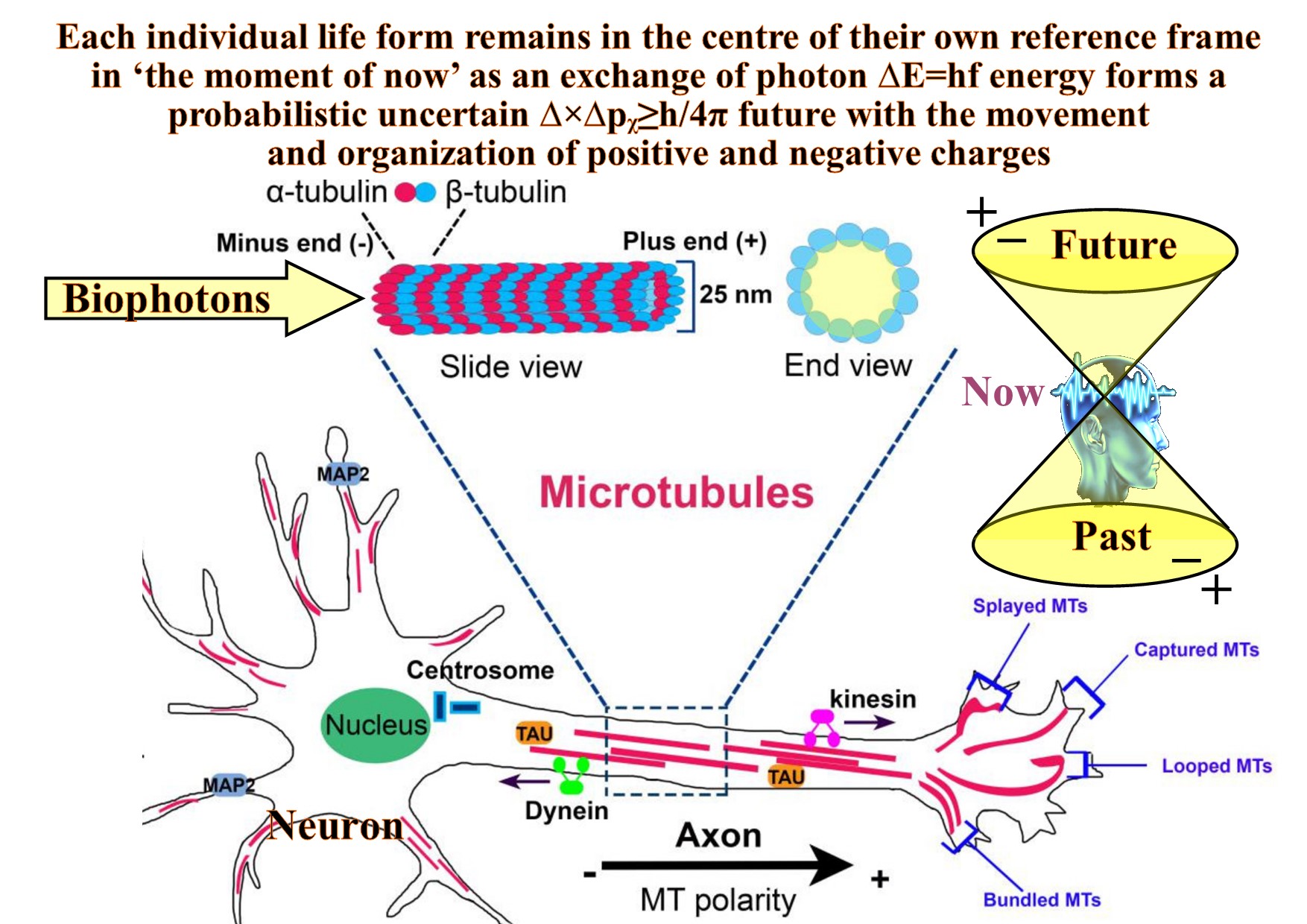
Both Classical Physics and Quantum Mechanics specify
how things are now. The Newtonian equations predict how they will be later on. The
equations of QM specify the probability of how things will be later on. The
logical explanation is that we have an uncertain future coming into existence
with potential photon ∆E=hf energy, of what might happen, exchanging into the
kinetic Eₖ=½mv² energy of electrons of what is actually happening. This forms
an irreversible probabilistic process with an uncertain future coming into
existence photon by photon with the absorption and emission of light waves.
Tuesday, 30 April 2024
Can Particles be Quantum Entangled Across Time?
Sunday, 21 April 2024
A general explanation of the physical Universe formulated by inductive r...
Tuesday, 16 April 2024
Theoretical physicist Sabine Hossenfelder asked "Why we have Units of ti...
Could the reason we measure in Units be because, the future is unfolding in units of unitary action or quanta? If we think of the future as emergent coming into existence quanta by quanta or photon by photon with the spontaneous absorption and emission of light waves. We would have an uncertain probabilistic future unfolding with each photon electron interaction. There is a geometrical aspect to this process with light waves radiating out spherically forming the characteristics of three-dimensional space with one variable in the form of time. This geometrical process would give us a reason way we measure in units as in time, length, energy and mass. At a deeper level, the spherical geometry of this process would explain why we have Ford cycles in our mathematics. Also such an emergent geometry would give us a reason why we have an infinite number of fractions between each two whole numbers.
Sabine Karin Doris Hossenfelder is a German theoretical physicist, philosopher of science, author, science communicator, YouTuber, musician, and singer. She is the author of Lost in Math: How Beauty Leads Physics Astray, which explores the concept of elegance in fundamental physics and cosmology, and of Existential Physics: A Scientist’s Guide to Life’s Biggest Questions.
Reference and Original Video:
The 5 Biggest Physics Mysteries #science #physics
https://www.youtube.com/watch?v=ABwkq...
Sabine Hossenfelder
1.25M subscribers
https://www.youtube.com/@SabineHossen...
https://www.youtube.com/watch?v=rOkGuFWD_Gg
Tuesday, 9 April 2024
In a solar eclipse we can see a hologram or holographic principle
Dyslexic Artist Theory on the Physics of Time
37.8K subscribers 2,513 views Jun 22, 2017
A wave and particle explanation of the electromagnetic spectrum
If the Universe is a hologram or uses the holographic principle in some way there should be extreme conditions when the hologram breaks down and we see the nature of reality in a different way. When a hologram is broken we see a whole image of the hologram in each individual broken part of the hologram this is also seen at a solar eclipse.
Saturday, 6 April 2024
How Quantum Systems (Measurement) are linked to increasing entropy driving towards equilibrium
This video answers the two question or problems we have with the Quantum Measurement System linked with entropy and equilibrium:
1. How can a
closed system form equilibrium or equilibrate?
2. How can unitary Evolution or unit a unitary action increase entropy?
Based on the theory explained in these videos.
The answer to question one is:
1. If the mathematics of Quantum Mechanics represents the physics of time with a probabilistic uncertain ∆×∆pᵪ≥h/4π future coming into existence with the exchange of photon ∆E=hf energy, because it is just the exchange of energy we can have the potential for equilibrium within a closed system.
The answer to question two is:
2. The absorption and emission of light waves are continuously forming photon energy, or unit of unitary action, transforming potential energy PE into the kinetic Eₖ=½mv² energy of electrons or matter will form statistical entropy naturally increase the potential for equilibrium.
The act of measurement in a quantum system forms a photon electron interaction with a probabilistic uncertain future unfolding into a well-defined outcome.
This would also explain why you need to cool down
your Photon detector so much, it is because we have the continuous exchange of
photon energy continuously unfolding all around us forming the continuum of
time!
~
Original video:
Quantum Measurements and Equilibration: Obtaining Information via
Entropy Maximisation
FQxI 37.2K subscribers
https://www.youtube.com/watch?v=d0pVo2bX-8c
Friday, 29 March 2024
What is Consciousness Hodgkin and Huxley Neuron model as a universal pro...
I would like to dedicate this video on Hodgkin and
Huxley model of Neurons.
That basically explains Neurons as electric circuits with the organization and movement of positive and negative charge. The positive and negative is in the form of ion atoms.
The neuron membrane acts as a boundary separating
charge with ionic gates embedded in the cell membrane forming the potential for
the build-up and movement of ion charge.
This process
can form signals along the neurons with the potential difference across the
cell membrane forming what is called an action potential.
To answer
this question we have to look deeper into the process.
When we do this, we find that the movement or
action of charged particles like ions emit photon ∆E=hf energy.
Therefore, this whole process can be based on an
interpretation of Quantum Mechanics
In the
theory explained in these videos, Quantum Mechanics represents the physics of
time ∆E ∆t ≥ h/2π as a physical process.
We have a probabilistic uncertain future coming
into existence with the absorption and emission of light with potential energy
PE continuously transformed into kinetic Eₖ=½mv² energy of electrons as an
uncertain ∆×∆pᵪ≥h/4π future comes into existence with each photon ∆E=hf electron
interaction.
With each photon electron interaction, a potential
future is emitted as a wave of probability with the past being annihilated in
the form of anti-matter annihilation.
Because light has momentum and momentum is frame dependent,
we can place each individual life form in the centre of their own reference frame
in the moment of now.
References:
There Are Biophotons in the Brain. Is Something
Light-Based Going On?
Neurons in the human brain produce photons, and are
apparently capable of being the infrastructure for light-based communication
and activity:
https://bigthink.com/mind-brain/there-are-biophotons-in-the-brain-is-something-light-based-going-on/
Photons guided by axons may enable
backpropagation-based learning in the brain:
https://www.nature.com/articles/s41598-022-24871-6
Neurons Unexpectedly Encode Information in the
Timing of Their Firing
A temporal pattern of activity observed in human brains
may explain how we can learn so quickly:
https://www.quantamagazine.org/a-new-kind-of-information-coding-seen-in-the-human-brain-20210707/
https://journals.plos.org/plosone/article?id=10.1371/journal.pone.0254152
Department
of Mathematical Sciences
B12412: Computational Neuroscience and
Neuroinformatics
The Hodgkin-Huxley model
https://www.maths.nottingham.ac.uk/plp/pmzsc/cnn/CNN3B.pdf
Introduction to Spiking Neural Networks: From a
Computational Neuroscience perspective
What
physicists refer to as photons, other people might just call light. As quanta
of light, photons are the smallest possible packets of electromagnetic energy:
https://www.symmetrymagazine.org/article/what-is-a-photon?language_content_entity=und
https://en.wikipedia.org/wiki/Photon
Schematic diagram outlining the potential modes of
biophoton network communication and repair among neurons. If a neuron is very
active or damaged (i.e., the biophoton neuron), its mitochondria may
communicate with other neurons (the bystander neurons) through either axonal
pathways and resulting synapse or through the extracellular matrix. The
biophoton neuron, if damaged, may also use biophotons to repair itself and
bystander neurons. Neurons that are not linked synaptically to the biophoton
neuron nor in a surrounding region (through extracellular matrix) would remain
unaffected (the unaffected neuron). Note that biophotons have a broad range of
wavelengths, from ultraviolet to red to infrared: